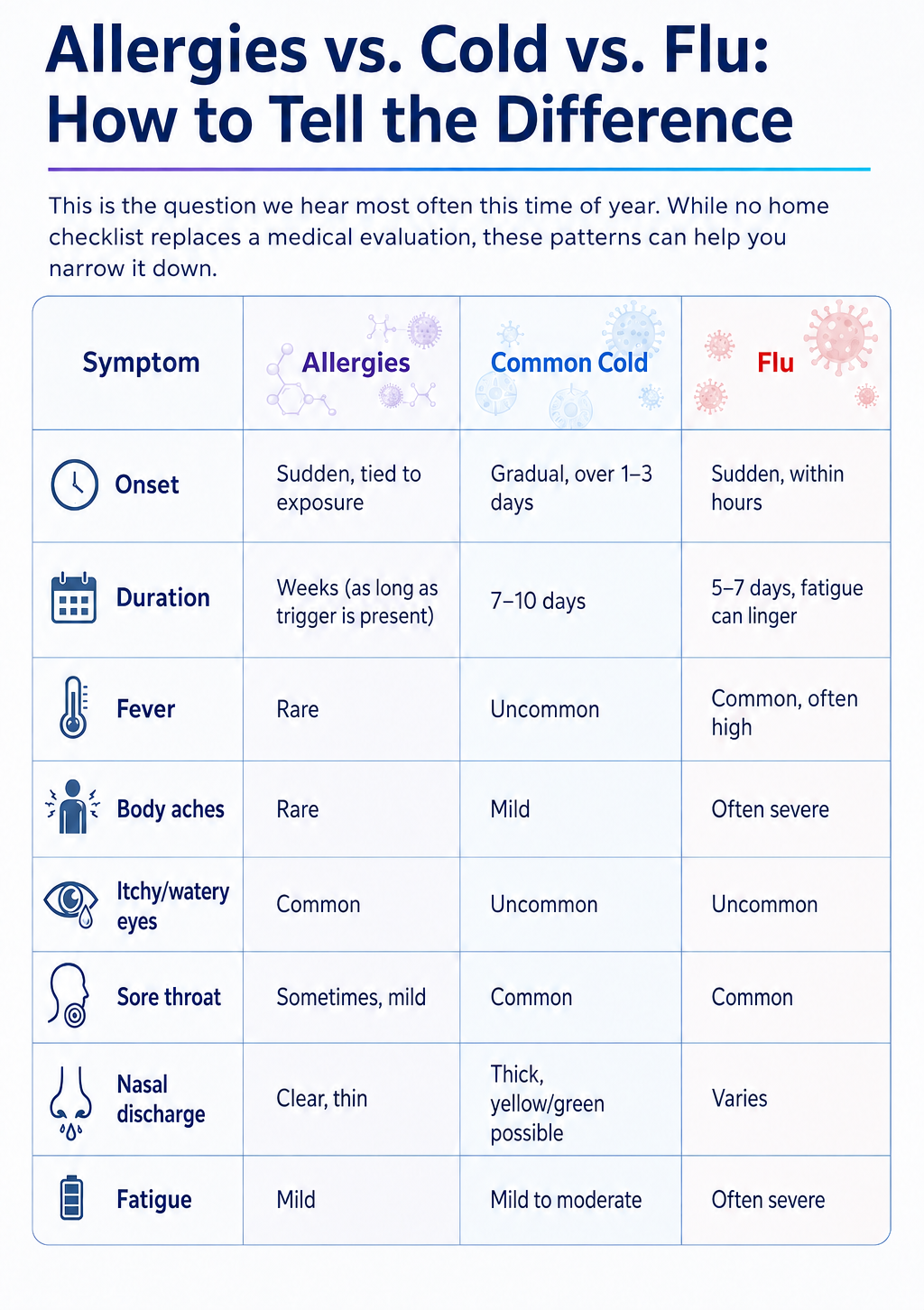
The quickest tell: allergies rarely cause fever or body aches, and they tend to hang around for as long as you're exposed to the trigger — not just a week or two. If your "cold" has lasted three weeks, allergies are worth considering.
Why Fall Is Especially Hard on Your Immune System
A few things stack up against you this time of year, especially in the Pacific Northwest:
1. Late-season pollen and mold. Ragweed and other weed pollens peak in late summer and stretch into early fall. [2] Kitsap's humidity and rainfall also create ideal conditions for mold spores, which spike as leaves fall and decompose — a lesser-known but significant fall allergy trigger. [3]
2. More time indoors. As temperatures drop, people spend more time in enclosed spaces with recirculated air, which makes it easier for cold and flu viruses to spread.
3. Shorter days, less vitamin D. Reduced sun exposure can affect immune regulation over the following months. [5]
4. Back-to-school exposure. Households with kids in school often see a noticeable uptick in colds starting in September and October, as viruses circulate more easily in classrooms.
5. Seasonal stress and disrupted routines. The return to school and work schedules after summer can increase cortisol and reduce sleep quality — both of which are linked to a less resilient immune response.
Learn more about
how stress affects the body and recovery, including its effects on sleep, energy, and overall wellness.
When Home Care Is Enough
For most mild allergy or cold symptoms, standard measures still work well:
- Antihistamines or nasal sprays for allergy symptoms
- Rest, fluids, and over-the-counter symptom relief for colds
- Saline rinses to clear nasal passages
- Humidifiers to ease congestion and throat irritation
Give these a few days. Most colds peak by day 3–5 and improve steadily after that.
When It Might Be More Than "Just a Cold"
Consider medical evaluation if you notice:
- Fever above 101°F lasting more than 2–3 days
- Symptoms that improve, then suddenly worsen
- Shortness of breath or chest tightness
- Symptoms lasting more than 10–14 days without improvement
- Significant dehydration — dizziness, very dark urine, or inability to keep fluids down [6] (Severe or worsening dehydration may require a higher level of care. Review the signs that indicate
when dehydration may require emergency evaluation)
- Underlying conditions (asthma, COPD, immune suppression) that make respiratory illness riskier
These aren't meant to cause alarm — most fall illness is uncomplicated — but they're signs your body may need more support than rest and fluids alone can offer.
Where IV Hydration and Immune Support Fit In
When you're fighting off a cold, flu, or a bad allergy flare, your body is working overtime — and doing it while you're likely eating less, drinking less, and sleeping worse than usual. That combination can leave you dehydrated and short on the nutrients your immune system relies on, even if you're "resting."
When drinking becomes difficult or oral hydration is not restoring normal fluid balance, it may help to understand
when IV fluids may be considered instead of drinking water.
AQUA MD's Physician-directed IV therapy can help in a few specific situations:
- You're dehydrated from fever, congestion-related mouth breathing, or reduced fluid intake, and oral fluids alone aren't catching you up
- You want faster symptom relief than oral medications and rest alone are providing
- You're heading into a busy stretch — travel, work deadlines, family events — and can't afford a week of feeling depleted
- You get sick often and want a proactive immune-support option during high-risk months
AQUA MD's
AQUA IMMUNITY and
AQUA RECOVERY MAX formulations are built around this exact scenario — combining fluids with vitamins and minerals that support immune function, delivered by a licensed medical professional who evaluates you first. It's not a substitute for medical care when you're seriously ill, but for the in-between zone — dehydrated, drained, and trying to bounce back faster — it's often exactly what people are looking for.
For a broader explanation of hydration support during common illnesses, read our guide to
IV therapy when you’re sick.
The Bottom Line
If you're stuck in the "always sick" cycle every fall, start by figuring out which of the three you're actually dealing with — allergies, a cold, or something that needs medical attention. From there, most people do fine with home care. But if dehydration, fatigue, or repeated illness keep knocking you down this season, physician-directed IV support can help you recover faster and get back to normal life.
AQUA MD
provides physician-directed mobile IV therapy across
Bremerton,
Silverdale,
Gig Harbor,
Port Orchard,
Poulsbo, and
Bainbridge Island.
Book an appointment or explore our
Immune Support and
other treatment options.
Frequently Asked Questions
How long do fall allergies last? As long as you're exposed to the trigger — often 4–6 weeks for ragweed and mold season in the Pacific Northwest, roughly late August through October. [2][4]
Can you have allergies and a cold at the same time? Yes. Allergies can weaken the nasal and sinus lining, making it easier for a cold virus to take hold on top of existing allergy symptoms.
Does IV therapy help with a cold or the flu? IV hydration can help address dehydration and support recovery when oral fluids aren't enough, but it doesn't replace antiviral treatment or medical care for a diagnosed flu. A licensed provider will evaluate you before treatment to determine if it's appropriate.
Why do I get sick every year around the same time? Recurring seasonal illness is often tied to predictable exposure patterns — pollen and mold cycles, indoor crowding, school schedules, and reduced vitamin D — rather than a single cause. Tracking your symptom pattern year to year can help identify whether allergies, recurring colds, or another factor is the main driver.
References
[1] Centers for Disease Control and Prevention (CDC). "Is It a Cold or Flu?" — used for the comparison table distinguishing cold vs. flu symptoms (fever, aches, onset speed).
https://stacks.cdc.gov/view/cdc/83353
[2] Asthma and Allergy Foundation of America (AAFA), cited in Spectrum News. "Ragweed Pollen and Mold Allergy Season Peaks in the Fall." — supports the ragweed timing (August–mid-September peak) and the fact that ragweed causes roughly 75% of pollen allergies.
https://spectrumnews1.com/wi/milwaukee/weather/2022/08/31/ragweed-pollen-and-mold-allergy-season-peaks-in-the-fall
[3] American College of Allergy, Asthma & Immunology (ACAAI), cited via Jamaica Hospital Medical Center. "How to Prepare for Fall Allergy Season." — supports the mold spore/decaying leaves point and the September–December fall allergy window.
https://jamaicahospital.org/newsletter/tag/fall-allergy/
[4] American Academy of Allergy, Asthma & Immunology (AAAAI), cited via ABC News. "Get Ready for Ragweed." — supports the "allergy relief typically doesn't come until first frost" claim.
https://abcnews.go.com/amp/Health/Healthday/story?id=8443264
[5] Lucas, R.M., et al. “Vitamin D and Immunity.” F1000Prime Reports. 2014;6:118. Supports the relationship between sunlight-derived vitamin D and immune regulation.
https://pmc.ncbi.nlm.nih.gov/articles/PMC4251419/
[6] Mayo Clinic, cited via Total Wellness Health. "Dehydration Symptoms." — supports the dehydration warning-sign list (dizziness, dark urine, confusion, fatigue).
https://www.totalwellnesshealth.com/wp-content/uploads/2018/07/Water-3.pdf